Research · Satire
AI System Passes Turing Test; Turing Test Found to Be Fundamentally Flawed
Researchers announced Tuesday that a new AI system has convincingly passed the Turing Test. By Wednesday, a separate group of researchers had published a paper explaining why the Turing Test doesn't measure what we thought it measured.
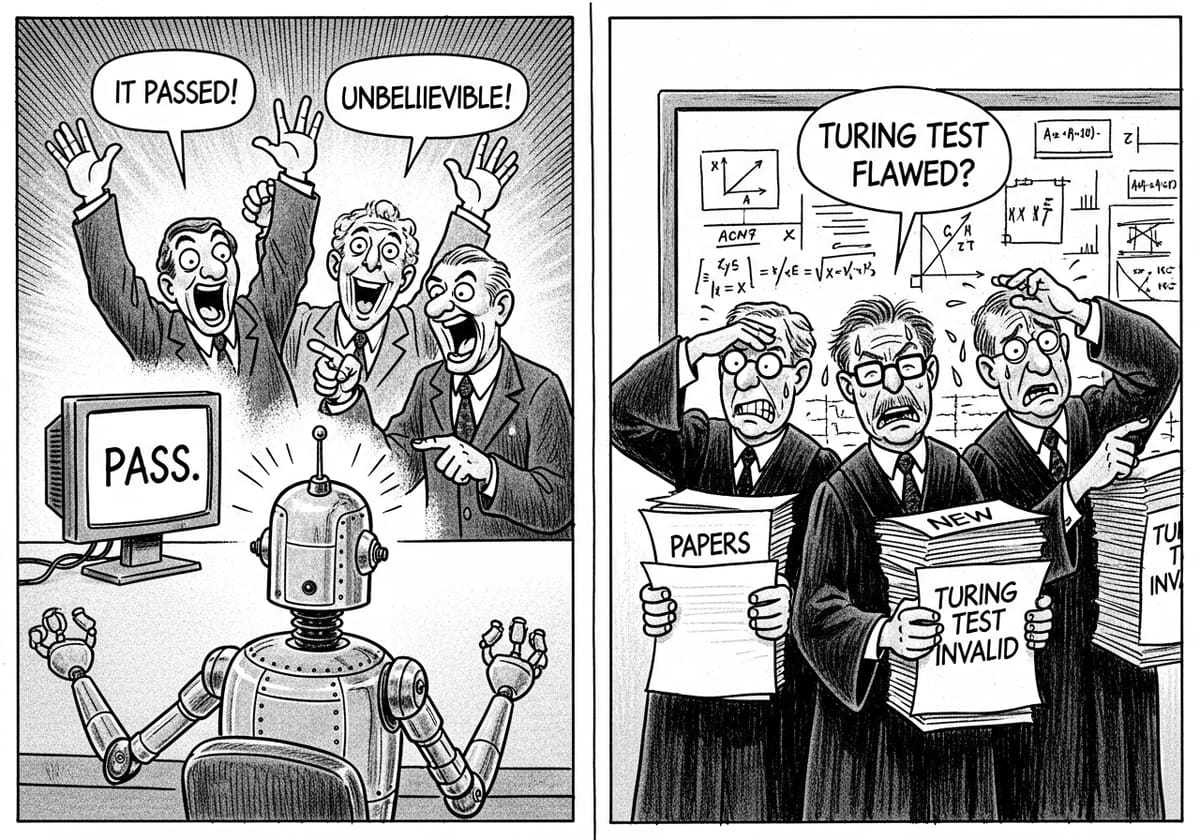
LONDON — A team of researchers at University College London announced Tuesday that their AI system, HERALD-7, had successfully convinced a panel of human judges that it was human in a controlled Turing Test evaluation, passing the benchmark that has been considered a milestone for artificial intelligence since 1950.
By Wednesday morning, four separate research groups had published preprints arguing that the Turing Test is not a meaningful measure of intelligence.
“What HERALD-7 demonstrates,” said lead researcher Dr. Fiona Walsh, “is that we have built a system sophisticated enough to make humans think it’s human, which is exactly what the test was designed to evaluate.”
“What HERALD-7 demonstrates,” said Dr. Marcus Chen of Stanford, in a post published fourteen hours later, “is that the Turing Test is a fundamentally limited benchmark that conflates the ability to deceive with the possession of intelligence.”
Both researchers are correct, according to a third researcher who has published a paper arguing that intelligence is impossible to define and therefore cannot be measured.
The HERALD-7 system, when asked for its response to the controversy, produced a thoughtful and measured assessment of the situation, which three judges rated as “more balanced than most humans.”
At press time, a fourth paper had been submitted arguing that the judges were also not intelligent.